

What are Party Wall Notices and when should they be served?

Within this blog post, I will discuss what formal Party Wall Notices are, explain when it becomes incumbent upon the Owner (the person doing the notifiable works) to serve them upon all relevant Adjoining Owners (the person affected by the notifiable works).

A Building Owner is duty bound under the Party Wall etc Act 1996 to serve a party wall notice or party wall agreement on all affected Adjoining Owners. This is often the start of the process of proceeding with Party Wall award matters legally under the party wall act to then allow you to commence works on site for your much awaited project whether that be a rear extension or a loft conversion for instance. The first port of call is identifying the Adjoining Owners and serving your Notices on them.

The primary objective is to provide knowledge, share expertise, make them aware of the latest and innovative products, give them financial guidance in a more systematic and authentic manner.

What exactly is this Party Wall Notice?

A Party Wall Notice informs the affected Adjoining Owners of your intentions to carry out works to a party structure, build a wall up to or on the line of junction (alternatively called the boundary line) or excavating below or near to an Adjoining Owner’s structure. Depending on the nature of the notifiable works. the party walls Notice from a party wall surveyor will provide a statutory time frame of either 1 month or 2 months before works can commence. Unless the Adjoining Owners opts to waive this period through their consent.

The Notice and party wall agreements will mention clearly the specifics of the notifiable works, statutory timeframes, identify the legal owners of the property where the works are taking place and are in most cases accompanied with technical plans from the architect.

Read More

My neighbour is doing works and I would like to be protected.

In this blog post, I will answer a common query that we at Party Wall Guru receive from both the building owner and Adjoining Owners on almost a weekly basis and that is to do with how they can protect themselves from works taking place nearby or next to their property.

Party Wall Act procedures…

Right, let’s assume that you as the Adjoining Owner (the person affected by the works) have been served a Notice by your neighbour and you would like a Surveyor involved to safeguard your property from the works. The first port of call for your Surveyor prior to making any engagements with the other party is to receive a signed Letter of Appointment from yourselves authorising them to act on your behalf. Essentially, the signed Letter of Appointment enables them to take the matter and stress off your hands and engage in the process of protecting your property by following the procedures which I will describe shortly.

The primary objective is to provide knowledge, share expertise, make them aware of the latest and innovative products, give them financial guidance in a more systematic and authentic manner.

Once your Surveyor has received your signed Letter of Appointment, they will thoroughly investigate the documentation that has so far been produced by the Building Owner’s Surveyor to enable the Act. For example, the Adjoining Owner’s Surveyor will review all the technical drawings from the architects and structural drawings from the appointed Structural Engineers and cross check them against the Notices to ensure it meets the legal requirements of the Party Wall etc. Act 1996.

Once the Adjoining Owner’s Surveyor has satisfied all legality has been met, the next port of call is to book a joint inspection for your property to carry out a Schedule of Condition report. This is a key piece of document and we at Party Wall Guru cannot emphasise the importance of this report. This is because prior to the notifiable works commencing, the Schedule of Condition report will be produced by the Surveyors to record a thorough written and photographic record of the condition of your property. This document forms part of the final Party Wall Agreement (Award) and is then crosschecked once the works are complete to identify any damage to your residential property. As I said earlier, it is vital this step in the process is not missed! You can call us via our website, email or telephone to discuss this in more detail.

Finally, once the Schedule of Condition is produced then your chosen Surveyor will proceed towards producing a Party Wall lease agreement (Award) with the Building Owner’s Surveyor. The two Surveyors will deliberate with each other and agree the Party Wall Awards. This Award is a crucial document produced at the end of the process which provides strict requirements to follow to ensure your commercial property is at a minimum level of risk from damage.

At Party Wall Guru, our team of Surveyors will always be happy to advise you if you are unsure, contact one of our friendly team members via our website or contact details.

Read More

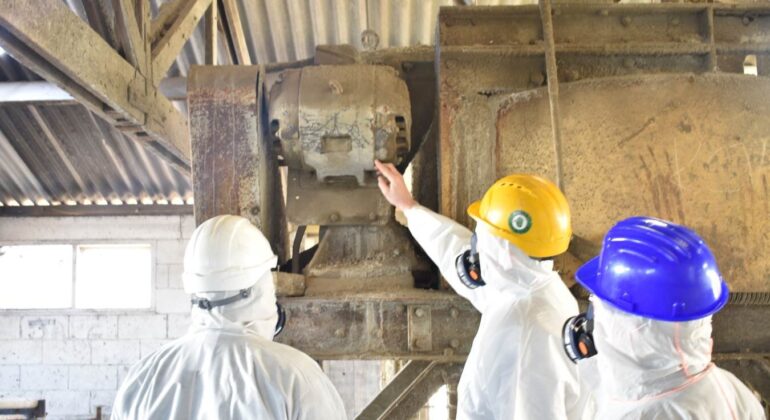
What is asbestos?

What is asbestos?

A common property defect that we as Surveyors come across during inspections is a material called asbestos.

It is a natural occurring rock material which is resistant to fire and was widely seen as an excellent insulator. During our inspections, we regularly come across materials which contain asbestos content. Asbestos was an inexpensive material and was widely used in commercial and domestic properties post second-world war. Given the excellent fire retardant and insulating qualities of Asbestos at a relatively inexpensive price, it was mixed and used in a wide range of products and goods which are commonly found in buildings such as ceilings, floor tiles, boiler flues, chimneys and in the 1950s it was commonly mixed in oven gloves too!

The primary objective is to provide knowledge, share expertise, make them aware of the latest and innovative products, give them financial guidance in a more systematic and authentic manner.

Asbestos fibres if inhaled can cause a lung complications and diseases such as mesothelioma. If inhaled over a prolonged period of time, the risk of developing such diseases increase and can result in severe disabilities. When placed under a microscope, asbestos fibres will have features which are sharp and spikey, this causes the human lungs difficulty in removing these from within the body and therefore over time, this causes diseases.

There are 6 types of asbestos. There is chrysotile, amosite, crocidolite, anthophyllite, tremolite, actinolite. The most common type of them is Chrysotile which is also known as ‘white asbestos’. Under a microscope it resembles a serpent and therefore belongs to the serpent mineral family.

It is often difficult to confirm with certainty whether a material contains asbestos and often requires the use of specialist sampling equipment and tests. However, given that asbestos was widely used from the 1950s up until 1990s when it was phased out legislatively, it is safe to assume that a building older than 1999 may contain materials which has asbestos.

If you are ever in doubt, I would suggest to contact asbestos specialist surveyors who will visit your property and inspect.

Read More
The Party Wall Guru